
Family of devices
Madrid-based Perseo Techworks began developing new subsea platforms several years ago. It secured the support of Navantia, a major shipbuilding company, which was willing to provide a range of technologies and production facilities. Additionally, Navantia-controlled SAES developed the electronics.
The first results of the project were presented in May 2023 at the FEINDEF exhibition in Madrid. Navantia's stand featured a model of an unmanned underwater vehicle (UUV), designated the S-UUV (Small Unmanned Underwater Vehicle). Promotional materials were also on display.
At that time, the project was still in the development stage, but its main objectives and features had already been revealed. In essence, it was a multi-purpose underwater platform capable of carrying various surveillance devices.
It was reported that the S-UUV project would reach the assembly and testing stage of a fully-fledged prototype in the foreseeable future. It was then planned to offer it to potential customers. Furthermore, medium- and heavy-duty UUVs were planned to be developed based on the existing technologies and solutions.
First result
On September 4, 2025, Arquimea Group SA, a Spanish company developing various unmanned and remotely controlled vehicles, announced the acquisition of Perseo Techworks. The company planned to continue developing Perseo's existing projects and then bring the finished products to market.

A few days later, the DSEI 2025 military-technical exhibition opened in London. At this event, Perseo once again showcased its UAV developments—this time as part of the Arquimea exhibit.
It has been revealed that the two-year-old S-UUV project has indeed progressed. Furthermore, it has been given a new name: S-Wise. Since then, Perseo Techworks has completed the design work and defined the final form of the UUV. A prototype was then built and tested. The vehicle has confirmed all its estimated characteristics and capabilities.
The S-Wise NPA is now being positioned as a fully-fledged product, ready for market launch. Arquimea and Perseo are expecting orders and plan to launch mass production soon. However, no indication of interest from potential customers has been reported yet.
Perseo Techworks previously mentioned the possibility of scaling up the technology and developing UUVs of different sizes and weights. These plans have likely not been abandoned, but their implementation has been put on the back burner for now. Recently, the company's primary focus has been completing the first S-UUV/S-Wise project.
Small-sized submarine
The S-Wise product in its current form is a miniature submarine capable of mounting various instruments and tools. Currently, components are offered for monitoring, surveillance, and reconnaissance, as well as for converting the UUV into a torpedo.
The UAV has a uniquely shaped hull. Its nose has an elliptical fairing and an increased diameter. Behind the forward instrument compartment, the hull tapers to a cylindrical shape. The aft end is conical.
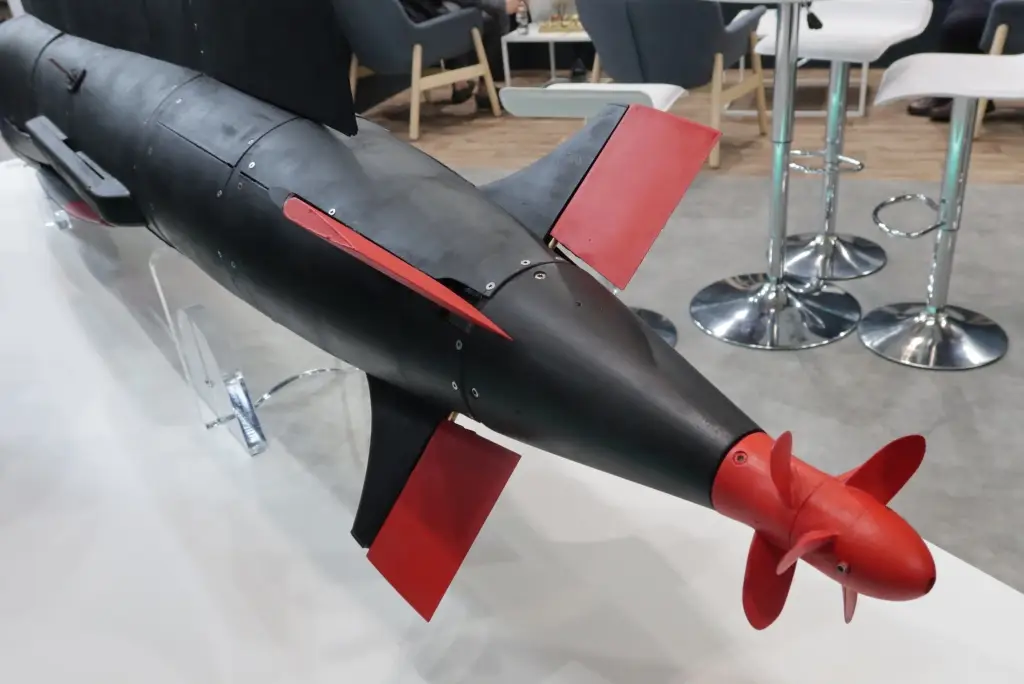
A narrow "superstructure" runs almost the entire length of the hull. It houses a video camera for driving, as well as several communication antennas. Various small fairings are located on the sides and bottom, designed to accommodate specialized equipment.
The hull can be manufactured using traditional technologies or additive manufacturing. 3D-printed structures allow for diving depths of up to 50 meters. A return to metal components allows for this capability to be increased to 300 meters.
The overall length of the aircraft is 2,23 m. The main hull diameter is 245 mm. The X-shaped stern surfaces have a span of 824 mm. The S-Wise's kerb weight, depending on materials and other factors, does not exceed 50 kg. Additionally, it is designed to carry a 30 kg payload.
The S-Wise project uses an electric propulsion system, the components of which were developed by Arquimea and Perseo. It is powered by lithium-ion batteries. Propulsion is provided by a 3 kW electric motor in normal mode or 6 kW for short-term acceleration. The maximum speed reaches 8 knots.
On the surface, the cruising speed is only 2,75 knots, providing a range of 85 nautical miles. Submerged, this figure is 3 knots, giving a range of 80 miles. Sustained cruising at 5,2 knots is possible, but the range will drop to 30 miles.
The UUV is equipped with a full-fledged Perseo ORA onboard computer. It collects data from all systems and sensors and controls various units. S-Wise can navigate a preset route and respond to emerging factors. The navigation system is capable of determining location both above and below the waterline. It incorporates satellite, inertial, and other instruments.




Leave your comments